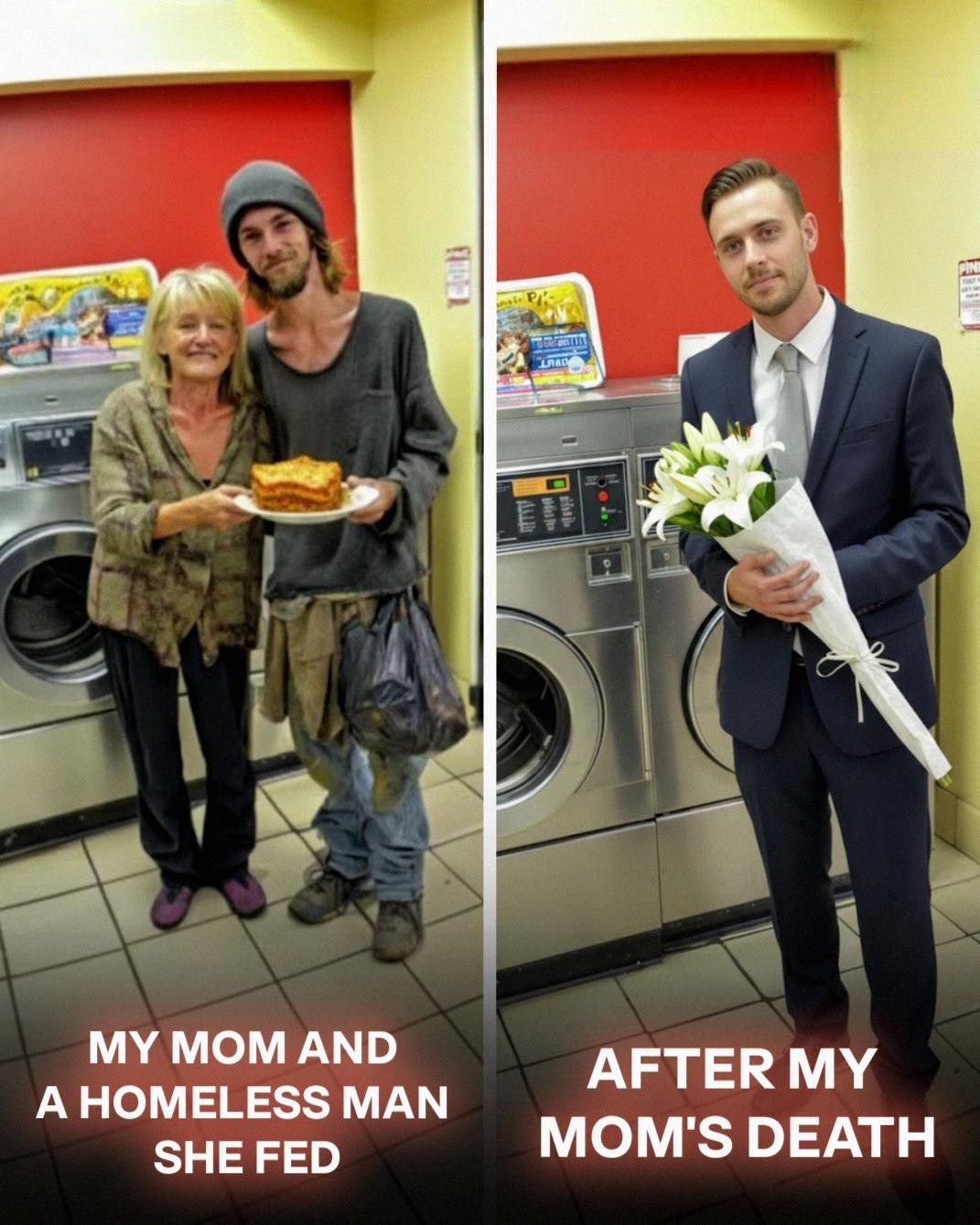
Every Christmas, My Mom Fed a Homeless Man at Our Local Laundromat — but This Year, Seeing Him Changed Everything
People love posting Christmas traditions like they’re proof that life is neat and predictable. Matching pajamas, coordinated cookies, perfect lighting. The kind of holiday you can package and sell.
Ours never looked like that.
Every Christmas Eve, my mom cooked a dinner that made our apartment smell like the version of home she was always trying to build—warm, steady, safe. If money was good, there’d be honey-glazed ham. If it wasn’t, she still made it feel like a feast. Mashed potatoes heavy with butter. Green beans fried with bacon. Cornbread that came out of the oven with a crust so golden it crackled when you cut it.
But the most important plate wasn’t ours.
She wrapped it in foil like it mattered more than everything else on the table, set it into a grocery bag, and tied the handles into a tight knot. She moved slowly when she did it, careful, like she didn’t want the warmth to leak out before it reached whoever was waiting.
I was eight the first time I asked.
“Who’s that for?” I said, watching her tuck the bag under her arm.
She didn’t look at me right away. She just pulled on her coat, checked that the bag was sealed, and said, “That one’s not for us.”
That answer didn’t satisfy me. Not then, not later. By fourteen, I was stubborn enough to demand the truth.
“Who is it for, Mom?”
She handed me my jacket. “Someone who needs it, baby.”
That was her whole explanation. No big speech. No moral lesson. Just a simple fact, like feeding somebody hungry was as normal as brushing your teeth.
We lived in a small town where everyone knew your business unless you were invisible. The invisible people were the ones you stepped around without noticing. The ones you pretended not to see so you wouldn’t have to deal with your own guilt.
There was an old laundromat at the end of our street, open twenty-four hours, lights always buzzing, air always damp with the smell of detergent and hot metal. That’s where he stayed.
His name was Eli.
The first year I saw him, he looked barely older than my cousin—late twenties, maybe. He wore the same battered hoodie every time, sleeves stretched thin at the wrists. He kept everything he owned in one plastic bag and a torn backpack that had seen too many winters. He slept curled in the corner near the soda machine, tucked into himself like he was trying to take up as little space in the world as possible.
He never begged. Never called out. Never even looked up when people walked in.
But my mom walked straight to him every year like he was expected.
She’d kneel down beside him so she wasn’t towering over him. She’d set the bag near his hands and speak softly, the way she spoke to me when I was sick.
“Hey,” she’d say. “I brought you dinner.”
Eli would sit up slowly, blinking like he wasn’t sure this was real. Then he’d say the same thing every time, voice hoarse, polite like he was trying not to be a burden.
“Thank you, ma’am. You don’t have to.”
And my mom would always answer the same way, calm and certain.
“I know. But I want to.”
When I was a teenager, I didn’t get it. I thought kindness had to come with a reason you could justify. I thought danger lived in people on the edges.
One year, as we walked back to the car, I whispered, “Mom, what if he’s dangerous?”
She didn’t flinch. She didn’t laugh. She just stared straight ahead, hands steady on the steering wheel.
“Dangerous is a hungry person the world forgot,” she said. “Not a man who says thank you.”
Over the years, pieces of Eli’s story slipped out, never all at once. My mom didn’t interrogate him. She didn’t pry. She just kept showing up. That’s what built trust.
When I was sixteen, Eli was awake when we arrived. He looked like he hadn’t slept in days, eyes raw, shoulders tense. Mom handed him the bag and asked, “You okay, Eli?”
He didn’t answer right away. Then, like something cracked open and fell out before he could catch it, he said, “I used to have a little sister.”
The words landed heavy.
“We aged out of foster care together,” he added quietly. “Then a car crash took her.”
He stopped there. He didn’t need to say more. Grief that old doesn’t come with neat details. It just sits in you.
That year my mom brought gloves with the dinner. Thick socks too. The next year there was a grocery card tucked inside the bag, and she lied badly, saying it “came in the mail.” Another year she offered to help him find a room.
Eli flinched like she’d offered him a trap.
“I can’t,” he said.
“Why not?” I asked, too blunt.
He looked down. “Because I’d rather freeze than owe anyone.”
I didn’t know if it was pride or fear, but my mom didn’t push. She just nodded.
“Okay. Dinner still stands.”
Then cancer came for my mother.
At first it was small things—tiredness, weight loss, her laugh sounding thinner. She tried to brush it off. “Probably my thyroid,” she said. It wasn’t.
She was gone in under a year.
We didn’t get one last Christmas together. We got a blurry fall full of doctors, paperwork, and watching the strongest person I knew disappear in pieces. By December, I was functioning, barely. Showering. Paying bills. Answering texts I didn’t care about. Pretending I was okay because people didn’t know what else to do with grief except expect you to tidy it up.
On Christmas Eve, I stood in her kitchen staring at the old roasting pan like it was a relic. I almost didn’t cook. I didn’t have the energy to recreate her rituals without her. But I could hear her voice in my head, steady and stubborn.
“It’s for someone who needs it.”
So I made what I could. Baked chicken instead of ham. Instant mashed potatoes. Canned green beans. Boxed cornbread. Not perfect, but warm.
I wrapped the plate in foil the way she always did. Tied the grocery bag handles tight. Got in my car and drove to the laundromat with my hands clenched around the wheel like the motion itself was keeping me from falling apart.
The laundromat looked the same from the outside. Flickering sign. Harsh fluorescent glow. The familiar smell of soap and damp air.
But inside, nothing was the same.
Eli was there—same place—but he wasn’t curled in a corner.
He was standing.
No hoodie. No blanket. No plastic bag. He wore a dark suit that fit him cleanly, pressed and sharp, like he’d borrowed it for something sacred. In one hand he held white lilies.
I stopped so abruptly my chest hurt.
He turned and saw me, and his face shifted—softened—like he’d been holding himself together by force and my presence loosened the grip. His eyes filled with tears.
“You came,” he said.
My throat tightened. “Eli?”
He nodded. “Yeah. It’s me.”
I lifted the grocery bag like I didn’t know what else to do. “I brought food.”
He smiled, but it was shaky. “She taught you well. Your mother.”
I stared at the flowers. “Why are you dressed like that?”
Eli looked down at the lilies, then back at me. “They’re for her.”
My heart lurched. “She’s gone.”
“I know,” he said quietly. “I tried to find you after the funeral. I didn’t want to intrude. But I needed you to know something. Something she asked me not to tell you until I could prove I wasn’t just the guy in the corner anymore.”
We sat down on the hard plastic chairs near the dryers, the machines thumping in the background like distant heartbeats. Eli placed the lilies beside him like they were fragile.
Then he asked, “Do you remember getting lost at the county fair when you were little?”
A cold shiver slid up my spine. I nodded slowly. “I… barely. I thought I imagined it.”
“You didn’t,” he said. “You ran up to me crying. You had a glitter butterfly painted on your cheek.”
My breath caught. That detail was too precise to fake.
“I held your hand and walked you toward security,” he continued. “A cop took you from me. Your mom came running when she saw you. She didn’t look at me like I was dangerous. She looked at me like I mattered. She thanked me, then asked my name. No one had asked my name in a long time.”
Tears blurred my vision.
“She came back the next week,” Eli said. “Found me here. Brought me a sandwich. She didn’t act like I owed her anything. She just fed me.”
He paused, swallowing hard. “And over the years, when she brought dinner, she’d tell me about you. Little things. ‘Abby passed her driver’s test.’ ‘She’s off to college.’ ‘She got her first real job.’ Like you were her whole world.”
My chest felt cracked open. “She talked about me? To you?”
Eli nodded. “All the time.”
Then he took a breath and said, “She also helped me. Not loudly. Not like a hero. She connected me to counseling. A job program. Training. It took years, but I got my footing. I worked. Saved. Stayed clean. Kept going.”
His eyes lifted to mine, steady now. “I promised her that if I ever made it, I’d wear a suit. So she could see I was okay.”
He reached into his coat and pulled out an envelope, worn at the edges like it had been handled a hundred times.
“She told me to give you this if I ever saw you again.”
Inside was a photo of me and my mom at the fair, young and smiling, cotton candy in our hands. And in the corner, slightly blurred, was Eli—standing nearby, watching like a quiet guard.
I pressed the photo to my chest and sobbed.
“She didn’t just feed me,” Eli whispered. “She saved me.”
He picked up the lilies, hands trembling. “Can I come with you? Just to say goodbye?”
I nodded because words didn’t work anymore.
We drove to the cemetery together, the food still warm on the passenger seat like proof that tradition could survive loss. Eli placed the lilies carefully on my mom’s grave and whispered something I couldn’t hear.
Then he looked at me, tears running down his face. “Before she got too sick, she asked me one more thing.”
“What?” I managed.
“She asked me to look out for you,” he said. “Not like a shadow. Not like a stranger. Like family. She said, ‘Be her guardian. Be the brother she never had. Be someone she can call when the world feels too heavy.’ And I promised.”
I broke down right there in the cold grass, grief hitting me full force, but something else too—relief. Because my mom was gone, but her choices hadn’t vanished. They were still moving through the world, still building bridges between people who needed one.
Eli knelt beside me and rested a hand on my shoulder, gentle and solid. “You’re not alone,” he said. “I know what it’s like to be alone. And I won’t let that happen to you.”
We went back to my place and ate together in silence, the kind that doesn’t demand anything, the kind that feels like understanding.
When he stood to leave, he paused at the door. “I’m not asking for anything,” he said. “I just needed you to know who your mother really was. And that I’m here if you ever need me.”
I heard my mom’s voice again, clear as if she were in the kitchen behind me.
“It’s for someone who needs it.”
So I opened the door wider.
“Don’t be alone tonight, Eli.”
His smile was small, grateful, almost disbelieving. “Okay.”
We sat on the couch and watched an old movie neither of us really followed. Somewhere around midnight, I realized the truth I’d been circling all night: my mom hadn’t just saved Eli all those years.
She’d saved me too.
She taught me that love doesn’t end when someone dies. It just changes shape. It keeps showing up—one plate, one person, one steady act at a time.
And now, in the quiet after grief, I had proof that family isn’t only blood.
Sometimes it’s the people who were fed by the same hands that raised you.
Sometimes it’s the people your mother refused to let the world throw away.
Sometimes it’s the person who shows up when it matters—because that’s what she taught them to do.